1. The Weakest Link: Why 85% of Customer Returns Are Hardware Failures
Over my eighteen years on the manufacturing floor at Naike, I have witnessed countless brands spend thousands of dollars perfecting their enamel artwork, custom plating colors, and retail blister cards, only to select the cheapest generic nickel-plated split ring from an unvetted local stamping vendor. Three months after the product hits supermarket shelves or online DTC stores, the one-star customer reviews begin flooding in: 'The ring stretched open when I put my house key on it,' 'The chain snapped while getting out of my car,' or 'The swivel head seized up and jammed completely.'
In commercial accessories engineering, a keychain is not a decorative ornament; it is a dynamic mechanical fastener. It resides in pockets and handbags alongside heavy brass key bundles, smart car fobs, and EDC pocket tools. It is subjected to constant bending moments, multi-axial torsion, sudden tensile shock loads when snagged on door handles, and aggressive galvanic corrosion triggered by skin perspiration and rain.
If an attachment joint fails, the emblem falls to the asphalt and is lost forever. To an end-user, an accessory that loses their car keys is not just a disappointment—it is an infuriating security hazard. That is why our technical department subjects every split ring, jump ring, lobster claw, and four-link chain to the same rigorous finite element stress analysis (FEA) and cycle fatigue benchmarks that we apply to automotive die-castings.
2. Metallurgy of Split Rings: Tempered Carbon Steel vs. Stainless Steel vs. Zinc
The traditional split key ring is an ingenious torsion spring coiled in a double overlapping helix. When a user pries the split coils apart to insert a thick 2.8mm brass car key, the wire experiences intense torsional shear stress. The fundamental question is whether the material deforms elastically and snaps back to zero gap, or yields plastically and remains permanently splayed open.
There are three primary alloys utilized across the global hardware industry:
Grade A: 65Mn Tempered High-Carbon Spring Steel (Naike Standard). We draw wire with 0.65% carbon content, coil it cold, and subject the coiled rings to an automated continuous mesh-belt furnace for quench hardening at 840°C in an oil bath, followed by rapid tempering at 420°C for 60 minutes. This metallurgical heat treatment achieves a Rockwell hardness of 42 to 46 HRC. When pried open by 3.5mm, our 65Mn rings exert a restoring spring force that snaps the gap back to under 0.12mm, guaranteeing lifetime zero-gap retention across 3,000 key insertions.
Grade B: AISI 304 / 316 Austenitic Stainless Steel. Used primarily for maritime, diving, and tactical military contracts. Stainless steel offers virtually permanent corrosion resistance without requiring electroplated coatings. However, because austenitic grades cannot be heat-treated to high hardness via quenching, they rely purely on work-hardening during wire drawing. Consequently, their yield strength is approximately 25% lower than tempered carbon steel, requiring a thicker wire diameter (1.8mm vs 1.4mm) to prevent permanent plastic splaying.
Grade C: Low-Cost Low-Carbon Wire (The Competitor Trap). Cut-rate factories use cheap Q195 cold-rolled wire (carbon < 0.12%) with zero heat treatment. It feels ductile and easy to assemble on the factory bench, but on the very first insertion of a modern thick car transponder key, it suffers catastrophic plastic deformation, remaining splayed open with a 2.0mm gap that allows keys to slide off effortlessly.
3. Jump Rings and Connecting Links: The Physics of Joint Failure
The jump ring is the small circular or oval metal loop that joins the main keychain emblem to the chain or split ring. Mechanically, it is the single most vulnerable component in the entire assembly.
Under pure tensile loading, an open jump ring acts as a curved beam subjected to bending moments. The maximum tensile stress occurs at the inner fiber diametrically opposite the open split. The failure mode is almost never tensile shearing of the wire itself; rather, it is bending moment yielding that forces the two wire ends to pry apart, creating a gap through which the emblem slips.
To prevent this, our engineering protocol mandates two strict manufacturing rules:
Rule 1: Wire Gauge Proportionality. The jump ring wire diameter d must equal at least 35% of the emblem's total thickness. For a standard 3.0mm thick die-cast zinc keychain weighing 28 grams, the jump ring must never use wire thinner than 1.4mm. Using 1.0mm wire is an immediate quality rejection.
Rule 2: Automated Plasma Micro-Welding (The Luxury Benchmark). For premium automotive brand clients, we deploy automated micro-plasma welding. After the jump ring is looped through the emblem's top loop, a precision plasma arc discharges across the seam in an argon gas shield for 8 milliseconds, fusing the two wire ends into a solid metallurgical joint. A welded 1.5mm jump ring can withstand over 32 kgf of tensile force before fracturing, compared to an unwelded ring that peels open at just 9.5 kgf.
4. Swivel Snap Hooks and Lobster Claws: Torsional Decoupling and Spring Fatigue
When a user drops their keys into a deep trouser pocket or clips them to a belt loop, walking motions introduce continuous axial twisting. If the keychain has a rigid, non-swiveling connection, this torsional load translates directly into cyclical bending of the chain links, rapidly leading to work-hardening fatigue and link fracture.
The solution is a multi-axis 360-degree swivel mechanism. Our heavy-duty zinc alloy lobster claws incorporate a cold-headed brass swivel rivet. During assembly, the rivet head is formed under an automated orbital riveting press that controls the axial endplay tolerance to precisely 0.15mm ± 0.05mm.
If the rivet is pressed too tightly, frictional binding prevents free rotation, forcing the chain to absorb the torsion. If the rivet is pressed too loosely, the swivel head wobbles, causing accelerated abrasive wear of the internal zinc shoulder that eventually leads to tensile pull-out under sudden snag loads.
Inside the snap hook trigger mechanism, spring selection is paramount. We reject ordinary music wire in favor of SUS302 stainless steel coil springs. While cheap carbon steel internal springs will rust and snap within six months of pocket moisture exposure, SUS302 springs retain 98% of their initial trigger closing force after 10,000 continuous push-release cycles on our automated pneumatic test bench.
5. Ball Chains vs. Curb Chains vs. Snake Chains: Tensile vs. Aesthetical Trade-Offs
Different brand aesthetics call for different chain architectures. Here is how our mechanical laboratory evaluates the top four chain formats:
Type A: Four-Link Flattened Curb Chain (Naike Industrial Standard). Formed from 1.6mm solid brass or iron wire, electrically resistance-welded at every link and diamond-cut on four sides. It delivers exceptional tensile breaking strength exceeding 24 kgf, drapes smoothly without kinking, and provides high surface area for electroplated gold or nickel mirror luster.
Type B: Beaded Ball Chains (Military Tag Style). Composed of hollow metal spheres connected by internal dumbbell pins. While economical and retro-tactical in appearance, ball chains have an inherent shear weakness: if caught on a door handle, tensile stress concentrates on the tiny spherical lip, leading to ball-pull rupture at loads as low as 7.5 kgf. We only recommend ball chains for lightweight promotional items under 15 grams.
Type C: Seamless Round Snake Chains. Delivering an ultra-modern, fluid jewelry drape with no visible links, snake chains are formed by interlocking metal cups. However, they are vulnerable to crushing and severe lateral bending. If a consumer sits on a snake chain against a hard chair, the interlocked cups dent and lock up permanently.
Type D: Direct Integrated Heavy Carabiners. For rugged outdoor, cycling, and EDC streetwear brands, we eliminate middle chain links entirely. We cast heavy-duty carabiner clips directly with custom zinc alloy emblems or connect via solid 25mm forged flat split rings, yielding a bomb-proof system capable of withstanding over 45 kgf of abusive pulling force.
6. Environmental Durability: Crevice Corrosion and Galvanic Coupling
When dissimilar metals are placed in electrical contact in the presence of an electrolyte (such as salty human sweat or rain), galvanic corrosion accelerates at an alarming rate. In a keychain assembly, the emblem is often zinc alloy (Zamak-3), the jump ring is brass, the split ring is tempered steel, and the swivel spring is stainless steel.
In our electroplating facility, we neutralize galvanic cell potential by applying a uniform barrier electroplating envelope across the entire assembly. All components receive an identical multi-layer coating: cyanide-free alkaline copper, bright acid copper, semi-bright nickel, bright nickel, and final electro-phoretic lacquer.
Furthermore, split rings present a notorious risk for crevice corrosion. Capillary action draws moisture into the microscopic gap between the two tightly coiled wire layers. If the ring is electroplated after coiling, chemical solution can become trapped between the inner coils, leading to internal rusting. To solve this, our coiled rings undergo ultrasonic agitation during rinsing cycles, followed by high-velocity hot air centrifuge drying at 90°C before lacquer immersion.
7. Procurement Engineering Checklist: What to Specify on Your Next Purchase Order
To protect your brand from hardware catastrophes, we urge procurement managers to mandate the following five technical clauses in their purchase specifications:
1. Material Specification: State '65Mn tempered spring steel, oil-quenched 42-46 HRC' for split rings. Reject generic 'carbon steel' or 'iron wire'.
2. Mechanical Pull Benchmark: Mandate 'Minimum joint tensile breaking strength > 18.0 kgf per ASTM F963-17 Clause 8.9'.
3. Cyclic Fatigue Guarantee: Require 'Split ring must withstand 2,000 openings to 3.0mm with residual gap under 0.15mm'.
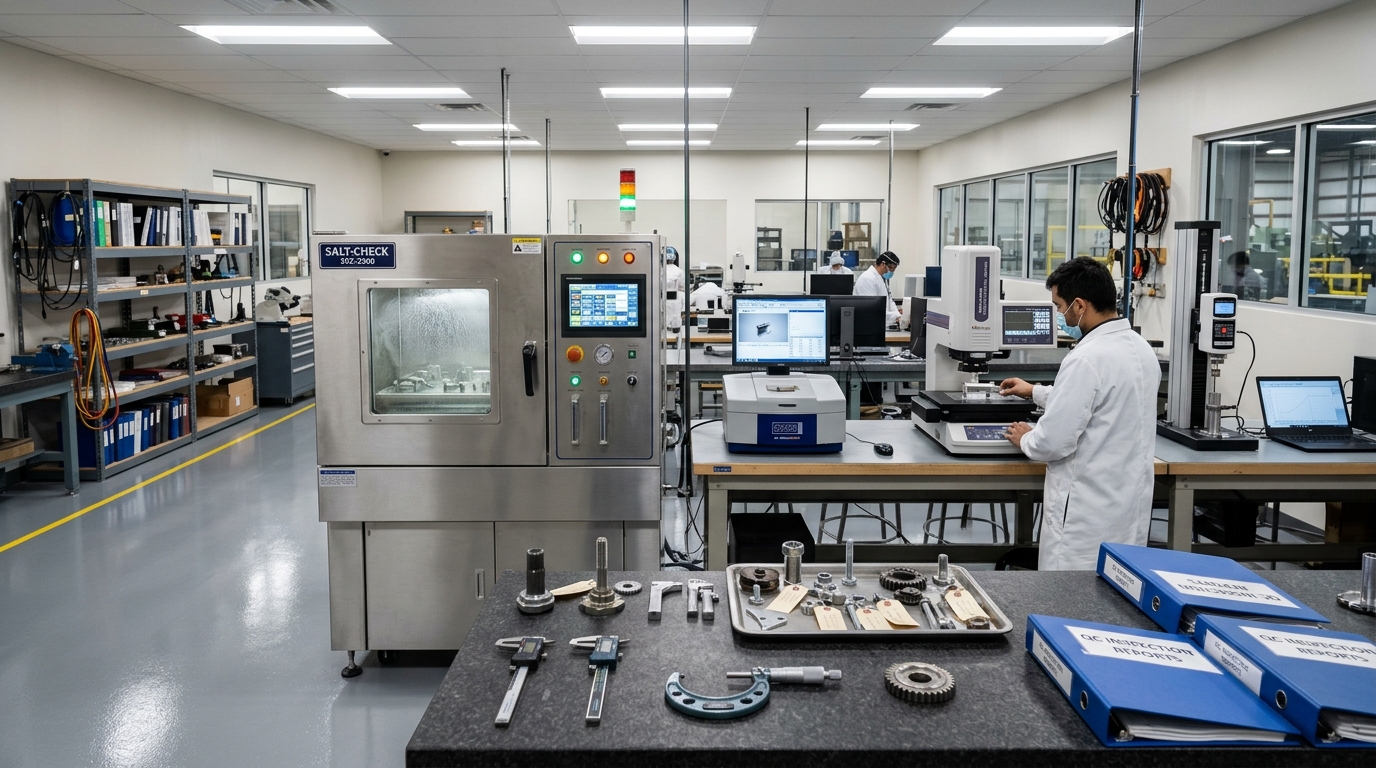
4. Plating Corrosion Barrier: Specify '72 hours Neutral Salt Spray testing per ASTM B117 with zero red steel rust or green copper spotting'.
5. Spring Material: Specify 'Internal snap hook springs must be SUS302 stainless steel'.